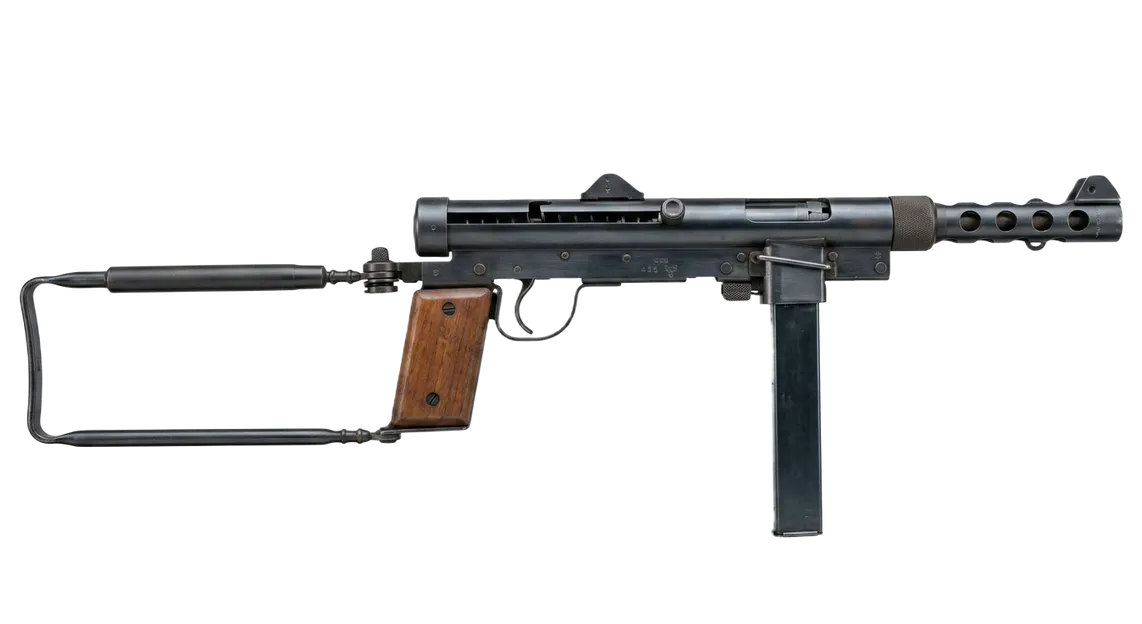
MP 40
9×19 mm Parabellum open-bolt blowback submachine gun produced in over one million units: a symbol of German WWII infantry and the first large-scale military weapon built around a stamped receiver and a folding metal stock.
MP 40
Community
Data trust
- Reliability
- Unverified
- Sources
- Sources pending review
Identity
- Designation
- MP 40
- Alias
- Maschinenpistole 40
- Manufacturer
- Erma Werke / Steyr / Haenel
- Country
- Germany
- Year
- 1940
- Category
- Submachine gun
- Status
- Historic
Ballistics
- Caliber
- 9×19 mm Parabellum
- Muzzle velocity
- 380 m/s
- Rate of fire
- ~500 rpm
- Effective range
- 100 m
- Maximum range
- 250 m
Dimensions
- Barrel length
- 251 mm
- Overall length
- 630 / 833 mm
- Empty weight
- 4 kg
Mechanics
- Operating system
- Blowback
- Bolt / action
- Automatica, otturatore aperto
Feed
- System
- Caricatore monofilare amovibile da 32 colpi
- Standard capacity
- 32 rounds
Fire modes
Historical profile
Development
The MP 40 was designed by Heinrich Vollmer at Erma Werke starting from the earlier MP 38, simplifying production through extensive use of stamped sheet metal and polymer (bakelite).
Adopted by the Wehrmacht in 1940, approximately 1.1 million units were produced through 1945, issued mainly to non-commissioned officers, paratroopers, vehicle crews and assault units.
Design
Chambered in 9×19 mm Parabellum, it operates on open-bolt blowback with a 32-round double-stack magazine. The relatively low cyclic rate (~500 rpm) makes it controllable in bursts.
It fires only in automatic mode (a production simplification), with a folding metal stock under the receiver. It was one of the first submachine guns to use no wooden parts.
Operational service
Often erroneously called 'Schmeisser' in Allied countries (Hugo Schmeisser was not involved in the project), it was used on all European and North African fronts.
The design profoundly influenced postwar submachine guns, from the Beretta M12 to the CETME C2 and the Steyr MPi 69. After 1945 numerous copies and variants were produced in Norway, Yugoslavia and Spain.
Variants
Main users
Germania (Wehrmacht, Waffen-SS) · Norway · France · Israele (Haganah) · Jugoslavia
Key components
- ●Stock — Shoulder rest.
- ●Receiver — Weapon body with internal mechanisms.
- ●Grip — Primary grip.
- ●Magazine — Cartridge feed.
- ●Barrel — Guides the projectile.
Community
Recent reviews
Similar systems
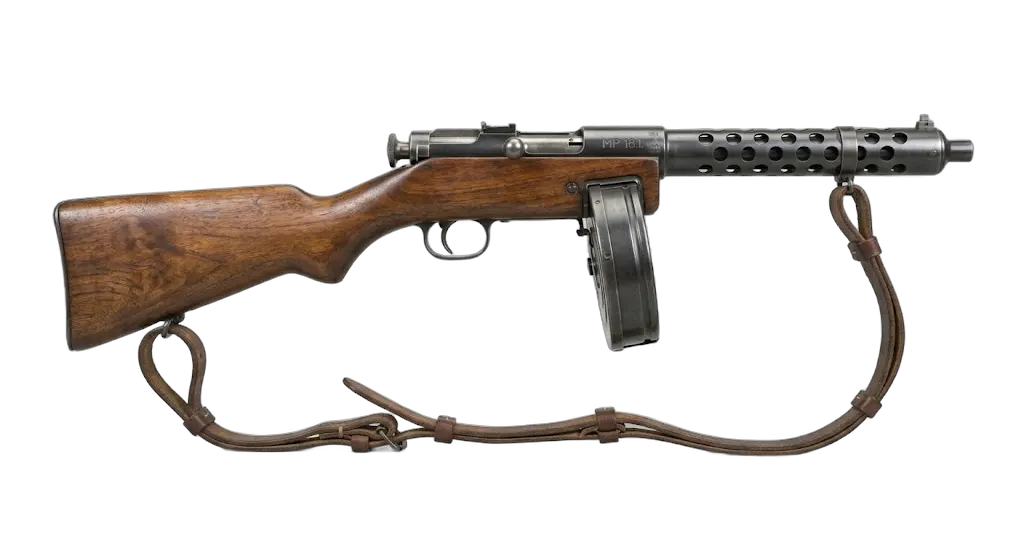
MP 18
1918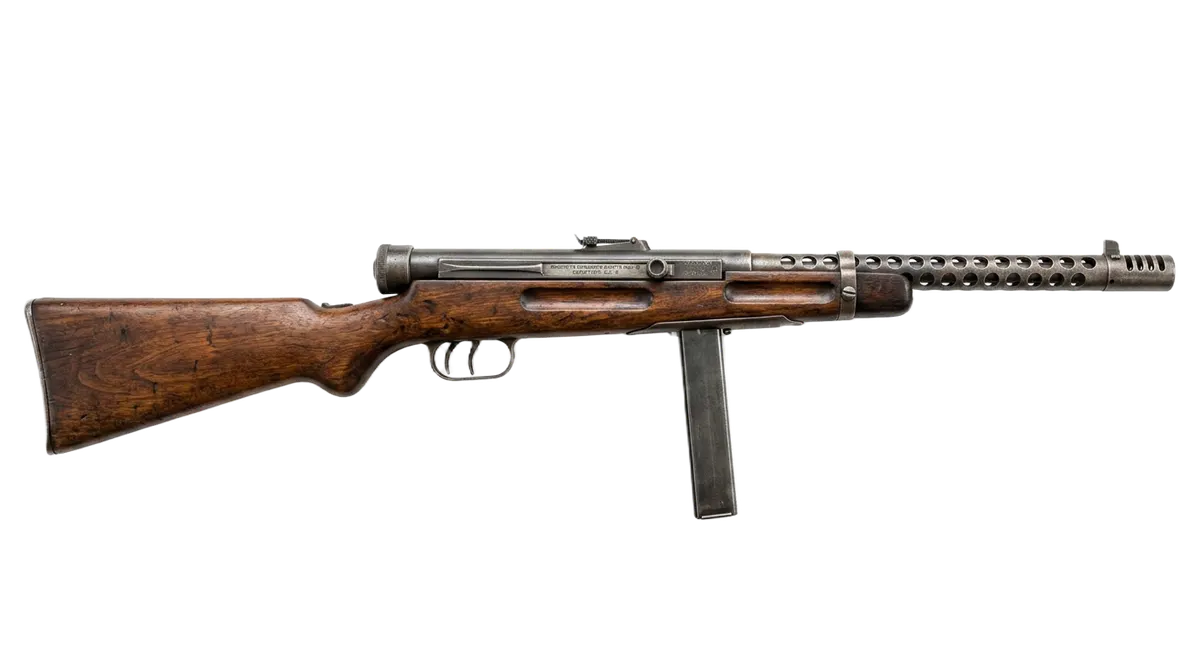
Beretta MAB 38
1938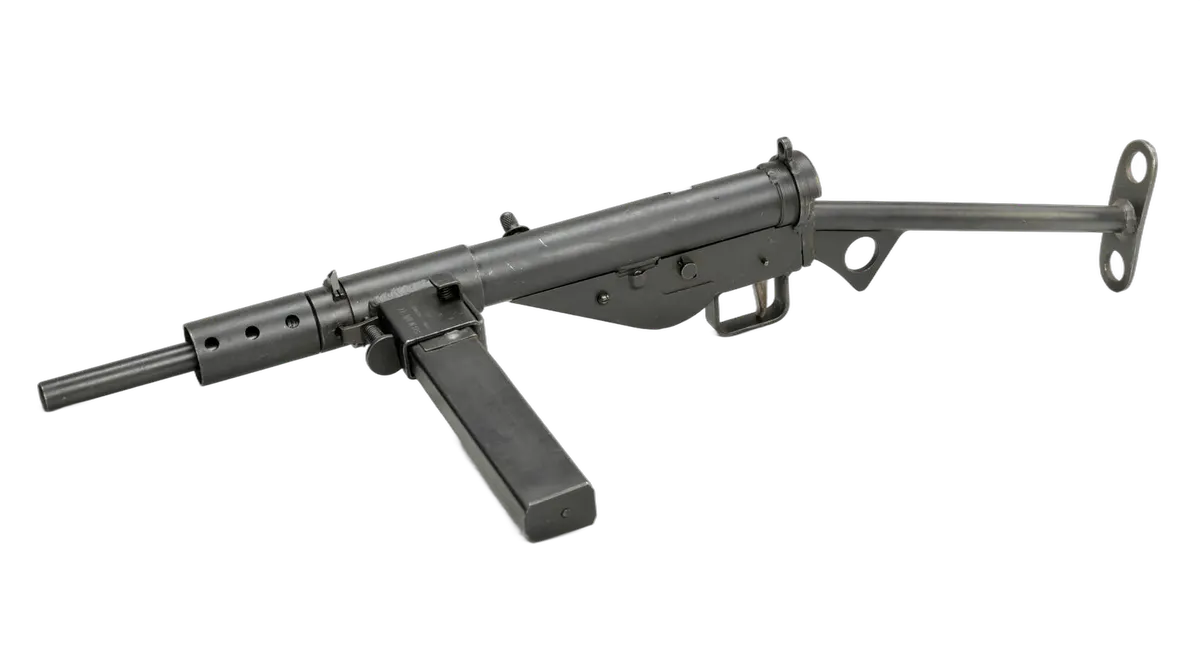
Sten
1941
MP41 (Furrer)
1941
Hispano-Suiza MP43
1943