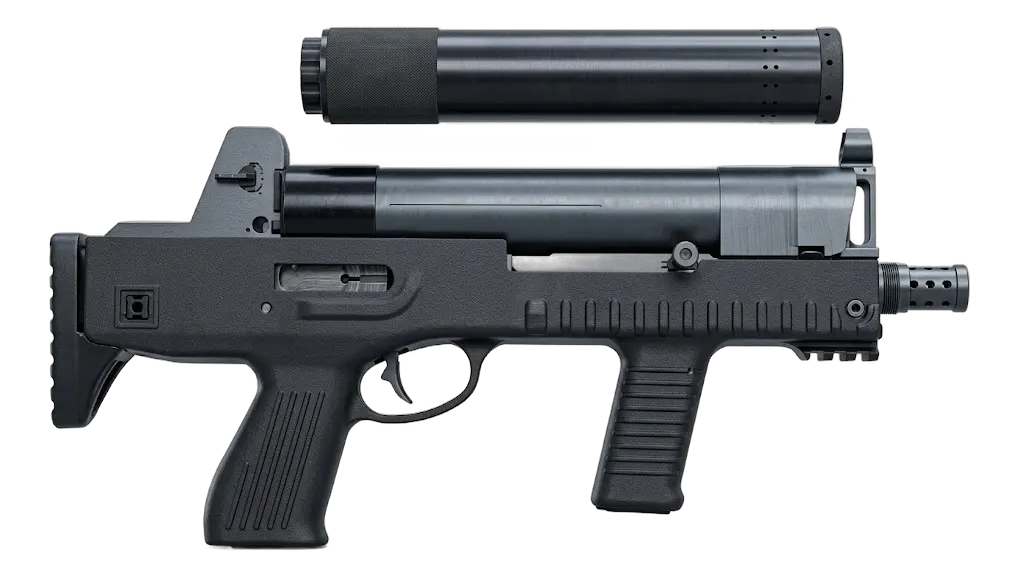
Magpul FMG-9
Country:  United StatesManufacturer: Magpul Industries
Folding 9×19 mm submachine gun prototype unveiled by Magpul in 2008. When folded it looks like a rectangular box; the action is based on the Glock 17/18.
Magpul FMG-9
Community
Data trust
- Reliability
- Unverified
- Sources
- Sources pending review
Identity
- Designation
- Magpul FMG-9
- Alias
- Folding Machine Gun 9
- Manufacturer
- Magpul Industries
- Country
- United States
- Year
- 2008
- Category
- Submachine gun
- Status
- Limited
Ballistics
- Caliber
- 9×19 mm Parabellum
- Muzzle velocity
- 360 m/s
- Rate of fire
- ~1100 rpm
- Effective range
- 50 m
Dimensions
- Barrel length
- 115 mm
- Overall length
- 250 / 530 mm
- Empty weight
- 1.4 kg
Mechanics
- Operating system
- Massa battente (azione Glock)
- Bolt / action
- Otturatore chiuso
Feed
- System
- Caricatore Glock 17/18
- Standard capacity
- 33 rounds
Fire modes
Historical profile
Genesis and Conceptual Development
The FMG-9 project originated from Magpul Industries' desire to demonstrate the versatility of modern polymers applied to concealable weapon systems for personal protection. Officially unveiled at the 2008 SHOT Show in Las Vegas, the prototype aimed to update the obsolete concept of the ARES FMG folding submachine gun from the 1980s, originally devised by Eugene Stoner and refined by Boatman.
The research and development phase focused on integrating reliable mechanics within a lightweight chassis that could be carried as a common briefcase or portable battery without arousing suspicion. The engineering team opted for a platform based on the Glock architecture, thereby ensuring immediate compatibility with magazines and components already widely prevalent in the military and law enforcement markets.
Architecture and Technical Design
The weapon features a reinforced polymer outer shell that serves as both a protective case and a stock once extended, minimizing the overall weight to approximately 0.5 kg. The heart of the system is designed to house the slide and barrel of a Glock 17 pistol, although the original prototype utilized the selective-fire mechanics of the 18-series to allow for automatic fire cycles.
The deployment mechanism is activated by pressing a quick-release button which, thanks to a series of pre-loaded springs, transforms the weapon into an operational configuration with a stock and grip in less than a second. A top Picatinny rail allows for the mounting of compact optics or laser sights, while the optional carrying handle can be removed to further reduce the profile of the closed device.
Operational Evaluation and Purpose
Although the FMG-9 was conceived for use by United States Secret Service agents and VIP protection details, the weapon never moved beyond the prototyping phase for official adoption. The primary criticisms concerned the complexity of deployment under stress and the legal restrictions imposed by the United States National Firearms Act, which classifies such devices as short-barreled firearms subject to stringent regulation.
Despite interest shown by various government agencies for its extreme concealability during undercover operations, Magpul chose not to initiate mass production, preferring to focus on the supply of accessories and firearm components. The design was nevertheless tested in various simulated scenarios, demonstrating superior shooting stability compared to a traditional pistol due to the presence of a fixed shoulder support point.
Commercial Evolution and Legacy
The technological legacy of the FMG-9 has survived through the collaboration between Magpul and ZEV Technologies, which in 2021 announced the FDP-9 (Folding Defensive Pistol) and FDC-9 (Folding Defensive Carbine). These new models correct the flaws of the original prototype, offering a legal version for the American civilian market and variants intended for sport shooting or home defense.
Beyond its impact in the firearms industry, Magpul's submachine gun achieved extraordinary popularity in digital media and video games, becoming a symbol of futuristic design and tactical innovation. Its unique aesthetics also influenced the airsoft market, where several licensed replicas were produced to satisfy the demand from collectors and enthusiasts worldwide.
Variants
Main users
Prototype, never in service
Key components
- ●Stock — Shoulder rest.
- ●Receiver — Weapon body with internal mechanisms.
- ●Grip — Primary grip.
- ●Magazine — Cartridge feed.
- ●Barrel — Guides the projectile.
Community
Recent reviews
Similar systems
PP-19-01 Vityaz
2004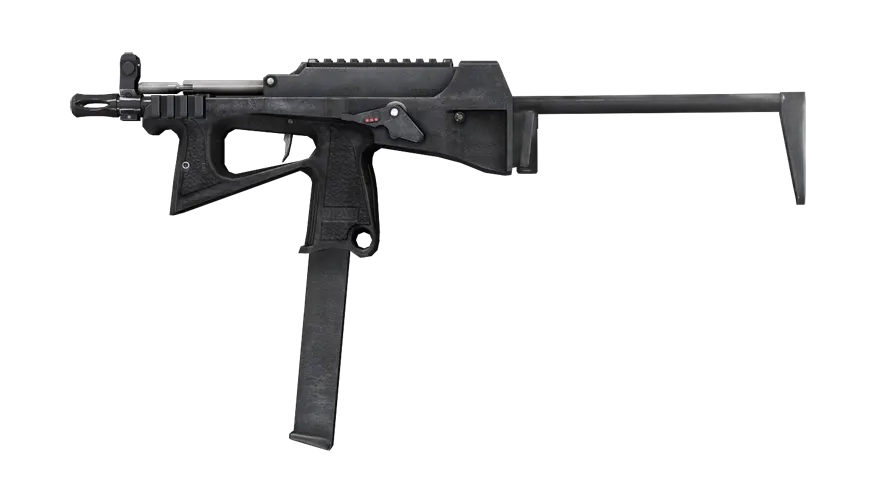
PP-2000
2006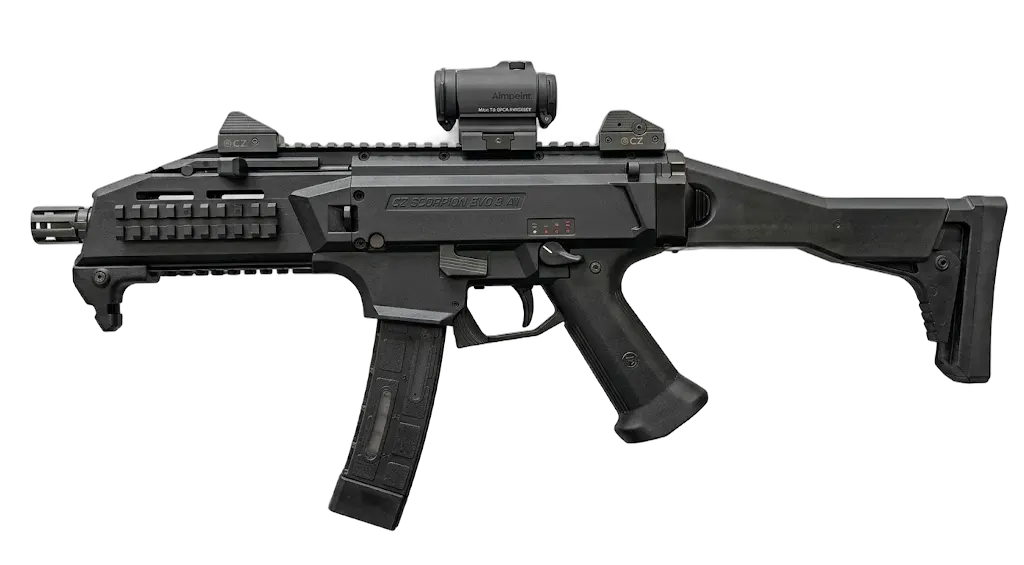
CZ Scorpion Evo 3
2009
Steyr TMP
1992
B&T MP9
2001