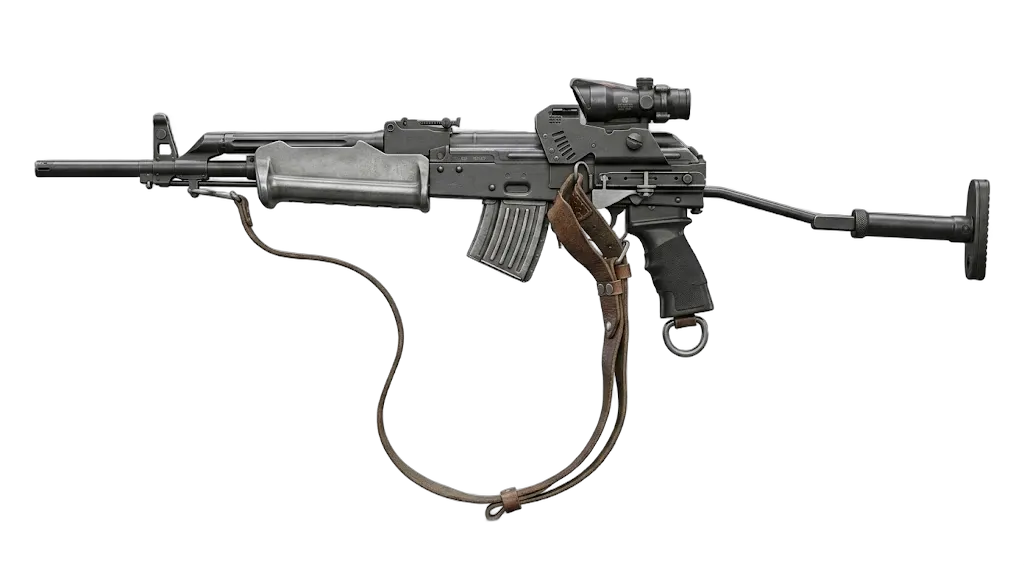
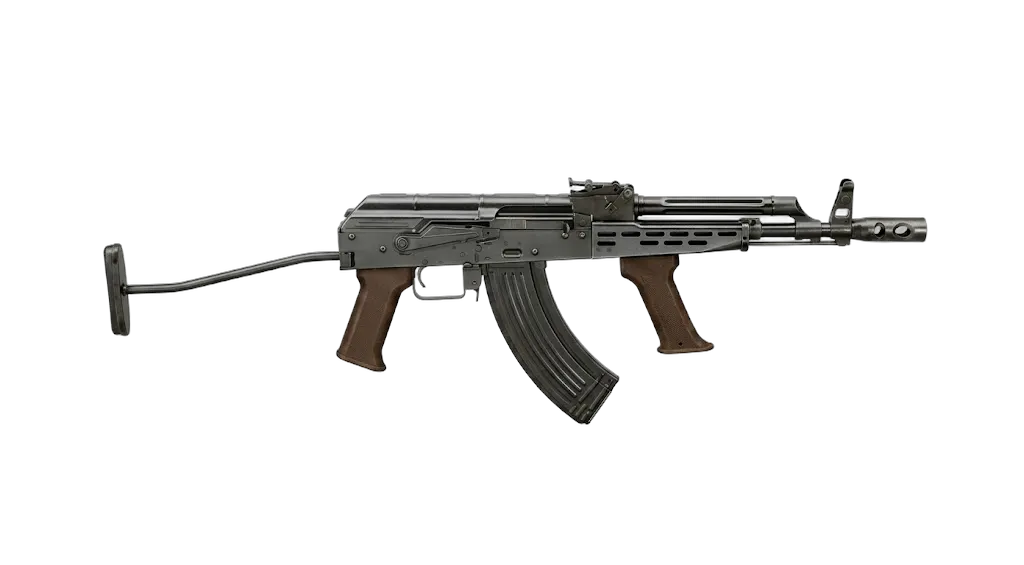
AK-47
Country:  RussiaManufacturer: Kalashnikov Concern (Izhmash)
Soviet assault rifle, icon of the Cold War. Rugged and reliable in any environment.
AK-47
Community
Data trust
- Reliability
- Partially verified
- Sources
- The Russian Way of War (Kalashnikov family and RPK; authors’ study, 2016)Army University Press / Foreign Military Studies Office · Accessed
- Last reviewed
Identity
- Designation
- AK-47
- Alias
- Avtomat Kalashnikova
- Manufacturer
- Izhmash / Kalashnikov Concern
- Country
- Russia
- Year
- 1949
- Category
- Assault rifle
- Status
- Historic
Ballistics
- Caliber
- 7.62×39 mm
- Muzzle velocity
- 715 m/s
- Rate of fire
- ~600 rpm
- Effective range
- 350 m
- Maximum range
- 800 m
Dimensions
- Barrel length
- 415 mm
- Overall length
- 880 mm
- Empty weight
- 4.3 kg
Mechanics
- Operating system
- Gas-operated, long-stroke piston
- Bolt / action
- Rotating bolt
Feed
- System
- Curved double-stack magazine
- Standard capacity
- 30 rounds
Fire modes
Production & service
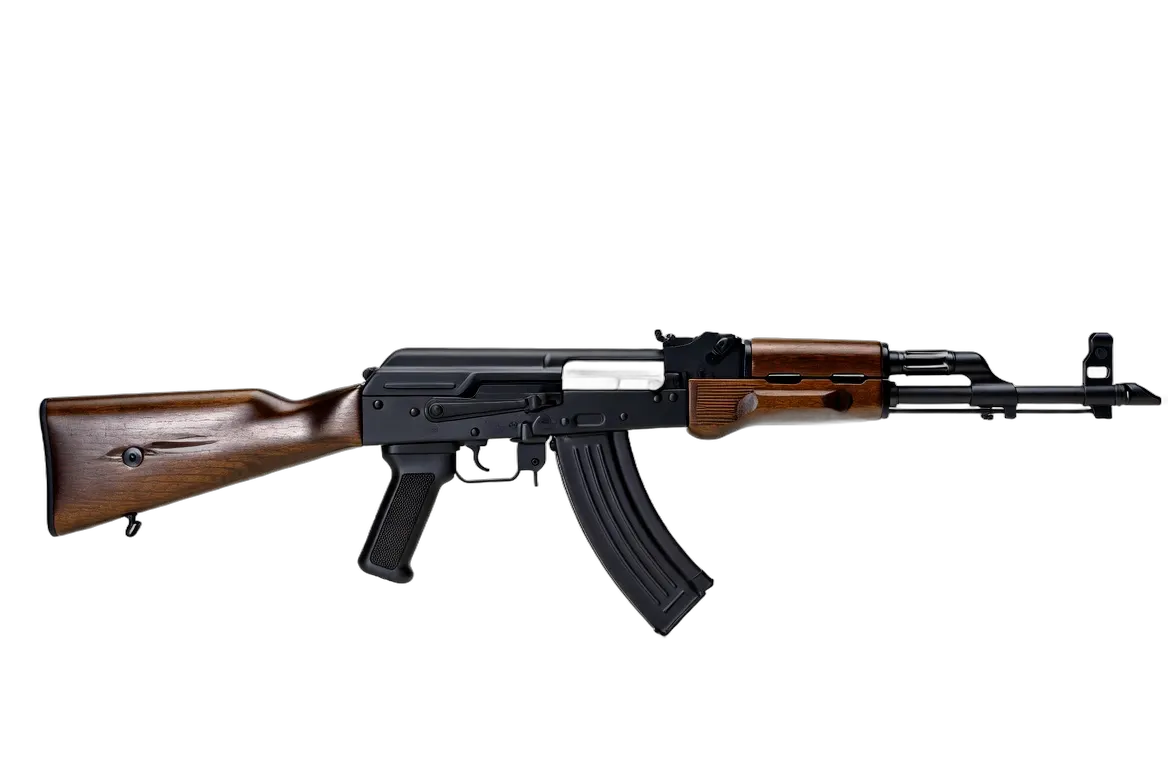
- ●AKM — 1959 modernized version with stamped receiver, lighter.
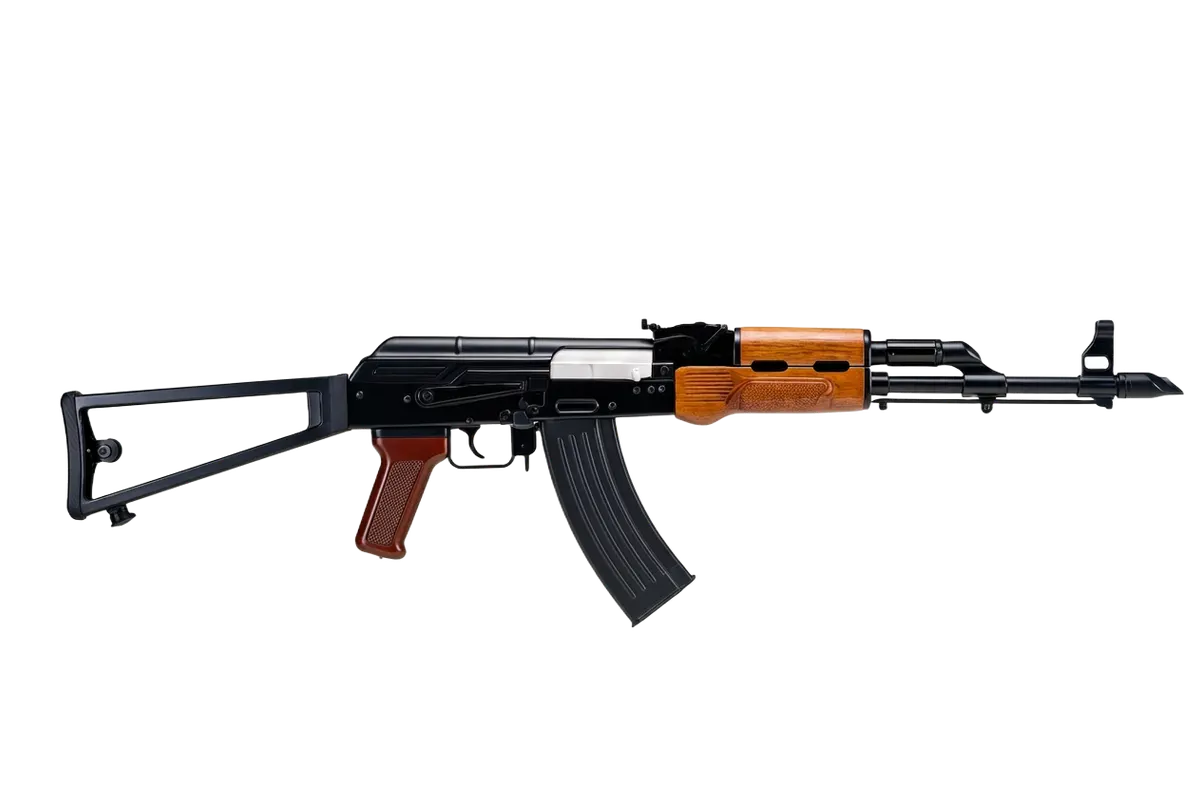
- ●AKMS — AKM with under-folding metal stock.
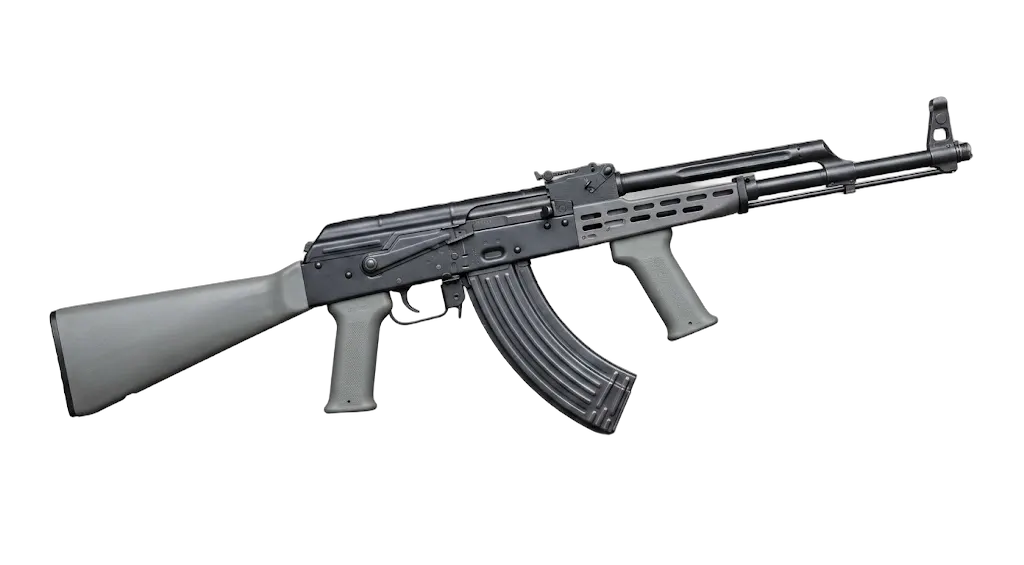
- ●Type 56 — Chinese clone produced by Norinco since 1956.
- ●M70 — Yugoslav Zastava variant with integrated bayonet.
Historical profile
Development
The project emerged in postwar USSR from the need for an intermediate-caliber weapon chambered in 7.62×39 mm, already introduced with the SKS semi-automatic rifle. Mikhail Timofeyevich Kalashnikov, a tank sergeant wounded at Bryansk in 1941, developed the AK-46 prototype and then the AK-47 at the Kovrov and Shchurovo proving grounds between 1946 and 1947.
The rifle was formally adopted by the Red Army in 1949 as the "7.62 mm Kalashnikov Avtomat" (AK). Serial production began at the Izhevsk arsenal (Izhmash).
Design
The AK-47 uses a long-stroke gas piston rigidly attached to the bolt carrier, with locking via a two-lug rotating bolt. Internal tolerances are deliberately loose: the rifle keeps running with sand, mud and minimal lubrication.
The first generation used a stamped sheet-metal receiver (Type 1), quickly replaced by a milled receiver machined from a solid billet (Type 2 and 3); with the 1959 AKM the stamped receiver returned, lighter and cheaper to produce.
Operational service
After Soviet adoption it was distributed across the entire Warsaw Pact and produced under license in China (Type 56), Poland, Hungary, Romania, East Germany, Bulgaria, Yugoslavia (M70), North Korea, Egypt and others.
It became the iconic weapon of 20th-century liberation wars: Vietnam, Afghanistan, Angola, Mozambique, the Horn of Africa, the Balkan wars. It appears on the flags of Mozambique, Hezbollah and Burkina Faso.
Legacy
Production estimates between originals and clones are 75–100 million units, making the AK family the most widespread firearm in the world. It remains in front-line or second-line service in over 100 countries.
The development line continued with the AKM (1959), the AK-74 in 5.45×39 mm (1974), the AK-100 series (1990s) and the AK-12 (2018), adopted by the Russian Armed Forces.
Variants
Main users
USSR · Russia · China · over 100 countries
Key components
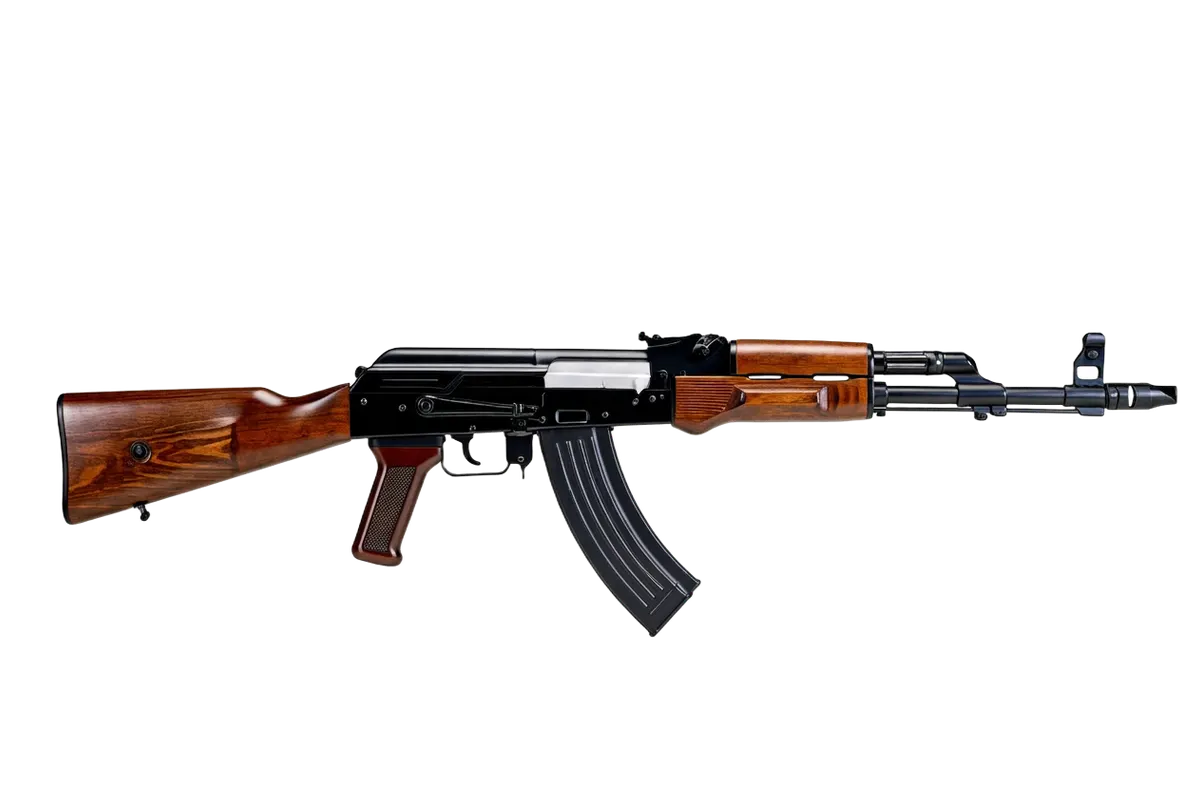
- ●Stock — Fixed wooden buttstock on the original AK-47 / Type 3 service rifle, mounted at the rear of the receiver.
- ●Receiver — Milled steel receiver housing the long-stroke gas-piston action and fire-control group, distinct from the later stamped AKM receiver.
- ●Grip — Pistol grip used as the firing hold; early service furniture was typically wood.
- ●Magazine — Detachable box magazine feeding 7.62×39 mm cartridges; the standard rifle magazine holds 30 rounds.
- ●Barrel — Barrel and gas block of the long-stroke Kalashnikov system, chambered for 7.62×39 mm.